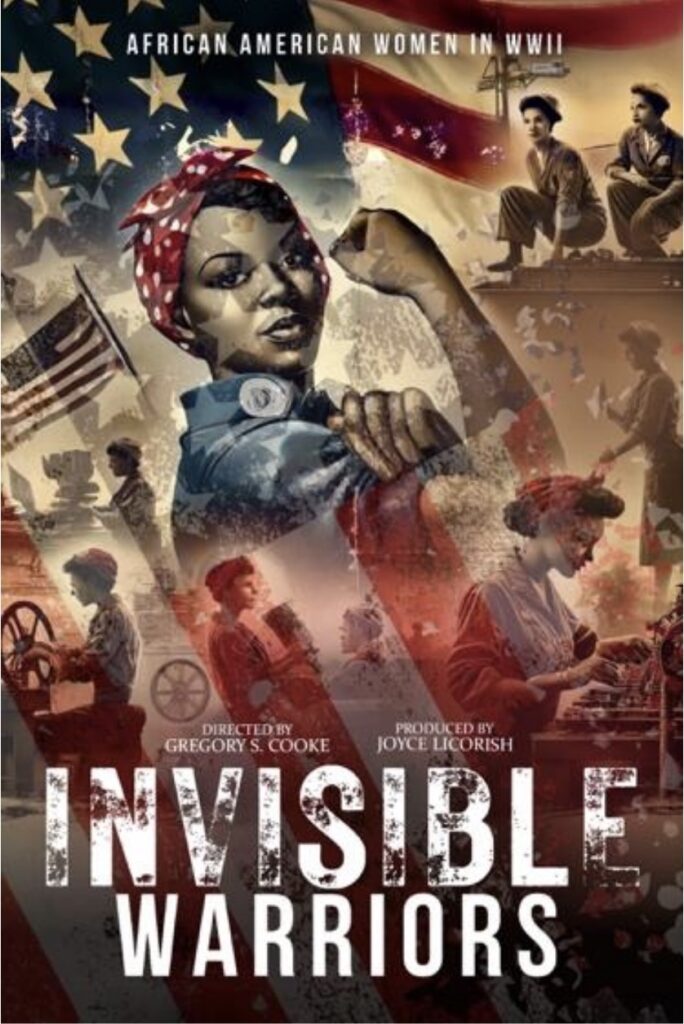
This is a powerful documentary about the women who helped our country during World War II against many obstacles. I enjoyed hearing the women’s experiences as they told their stories…. I learned so much from this film and was surprised to learn that the nearly 600,000 African American women that helped the country during the war have been largely ignored by history.
—KIDS FIRST! Film Critic Julie O. , So Cal City Kids
Today, we recommend the film Invisible Warrior. Most people are familiar with Rosie the Riveter as a symbol of the women who, for the first time, took on jobs outside the home to keep this country going during World War II. However, not all women engaged in this effort fit that iconic lilywhite image. There were plenty of black women filling necessary jobs as well, and they had it twice as hard. Not only did they have to deal with the same problems as the white women they worked alongside, but they also had to deal with racial prejudices even from their own co-workers. This eye-opening film highlights both their contributions and their struggles.
…an important documentary with a powerful message.
An excellent effort to preserve history for future generations to learn from, Invisible Warriors: African American Women in World War II is an important historical film that Cooke put an incredible effort into creating a solid historical account, featuring personable interviews and pointed choices in archival imagery, which is abundant. It offers a refreshing perspective on women’s U.S. history, supporting a belief in patriotism that all people matter and are part of a structure that has allowed progress to occur. Invisible Warriors could not be more apropos than in our current times for looking back to move forward.
Invisible Warriors could not be more apropos than in our current times for looking back to move forward.
ACADEMIC ACCLAIM
Impeccable research is a pillar of documentary filmmaking. The world-class scholars appearing in Invisible Warriors: African American Women in World War II have dedicated their professional careers to teaching and documenting social, historical, and political phenomena related to Americans whose experiences have been traditionally marginalized because of their race or gender.
Here is what scholars Darlene Clark Hine, Maureen Honey, and Janet Sims-Wood say about Invisible Warriors – followed by a serenade from Johnny Hartman.
Darlene Clark Hine

Chair, Department of African American Studies Northwestern University & Co-Author of "The African-American Odyssey"
“Invisible Warriors: African American Women in World War II is a powerful, important – indeed, essential – documentary project that gathers and preserves an array of amazing voices of brave African American women who contributed so much to struggles for justice and freedom at home and abroad during the World War II era. Invisible Warriors sheds new light on, and deepens our understanding of, Black women’s activism in the war that transformed Black America. Black women such as the young Dorothy Height and nurse Mabel Staupers helped to make the ‘Double V’ campaign a vital reflection of black self-determination and social change agency.
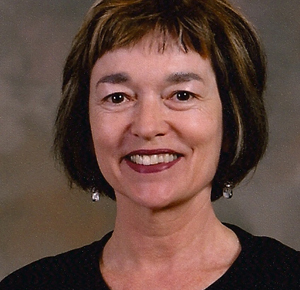
Maureen Honey

Professor of English and Women’s Studies University of Nebraska–Lincoln & Author of "Bitter Fruit: African American Women in World War II"
“It’s high time a film of this nature was made about the ‘invisible’ women warriors of World War II – African American ‘Rosies’ who were waging a ‘Double Victory’ campaign against fascism abroad and racism at home. We need Invisible Warriors: African American Women in World War II now more than ever so we can honor the foremothers who paved the way to a better America in the 21st century.
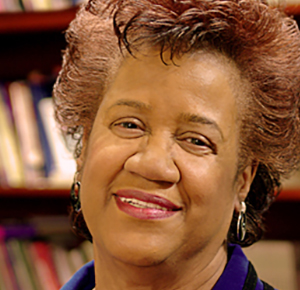
Janet Sims-Wood

Assistant Chief Librarian (Ret.) Moodland-Spingarn Research Center (MSRC) Howard University
“Invisible Warriors gives voice to African American women of the ‘greatest generation’ who fought for Civil Rights, helped the war effort by working in factories, and served their country as soldiers. These are the untold and often unknown stories of exceptional pioneers who saw a need and, despite the discrimination they faced daily, put fear aside and stepped forward to fill that need. These are the stories that future generations need to hear.”